
What Size Deck Box Do You Need for Patio Cushions? A Small-Patio Guide
Capacity in gallons is only a starting point when choosing a deck box for patio cushions. Learn how to measure cushions, compare usable interior dimensions, test storage arrangements, and protect limited patio space before buying.
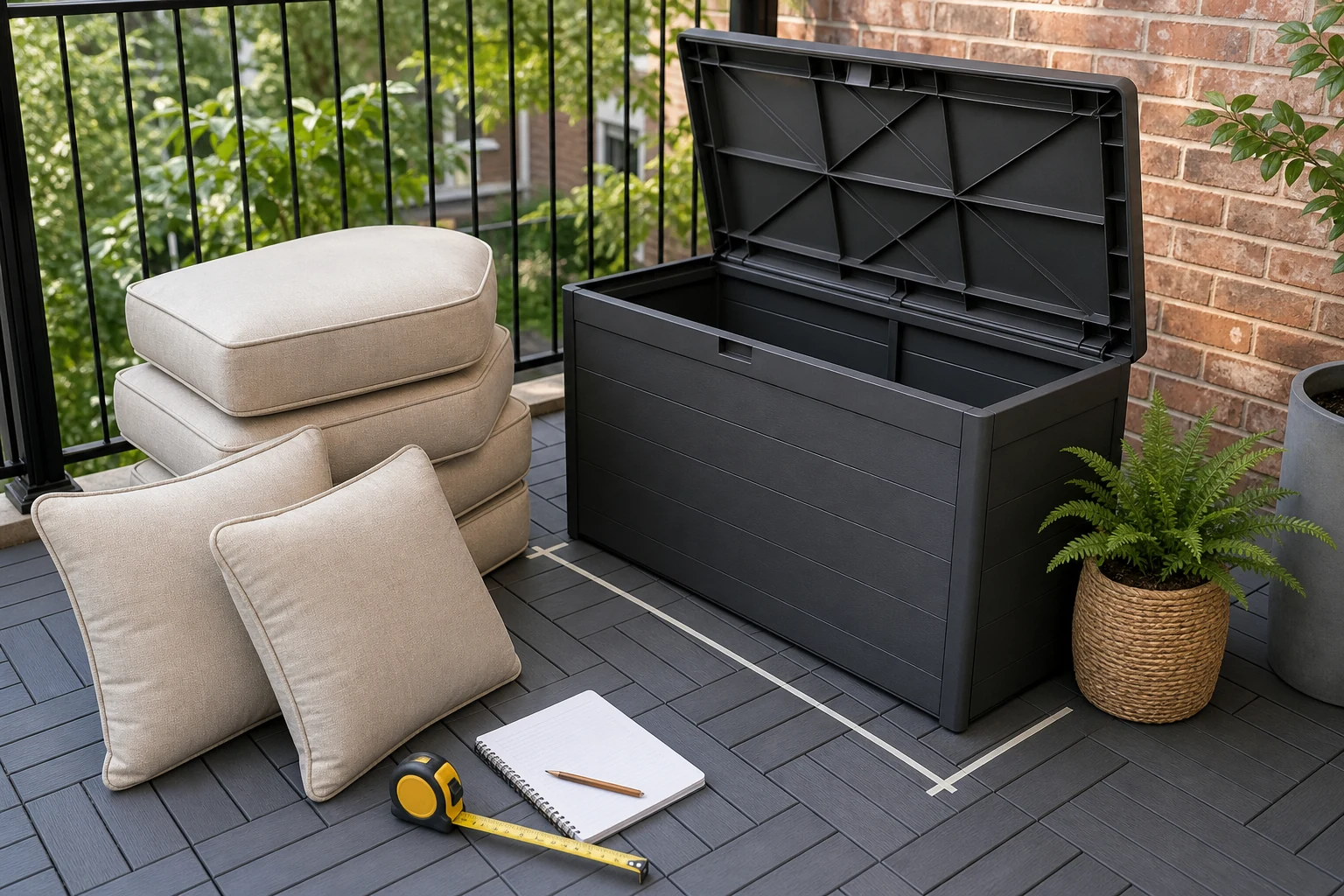
A 30-gallon deck box is not automatically large enough for patio cushions. To choose the right deck box size for cushions, measure every cushion, compare those measurements with the box’s usable interior dimensions, and test whether the cushions fit stacked or upright. Then check the box’s exterior footprint, lid clearance, and walking space. A small deck box for patio cushions may work for a compact set, but gallon capacity alone cannot confirm the fit.
Measure the cushions before shopping
Start with the cushions you plan to store together. Measure each one in inches while it is in its normal, uncompressed shape:
- Width from side to side
- Depth from front to back
- Thickness from edge to edge
- Quantity of each cushion
Separate seat cushions from softer back cushions. Seat cushions are often more rigid and may determine the minimum box width or depth. Back cushions may compress somewhat, but do not count on compression to solve a tight fit or make a sealed container easy to close.
Record the largest measurement in each category. If cushions vary in size, use the actual dimensions of the largest cushion rather than an average. Also note whether straps, ties, covers, or attached sections add bulk.
Compare usable interior dimensions, not gallons
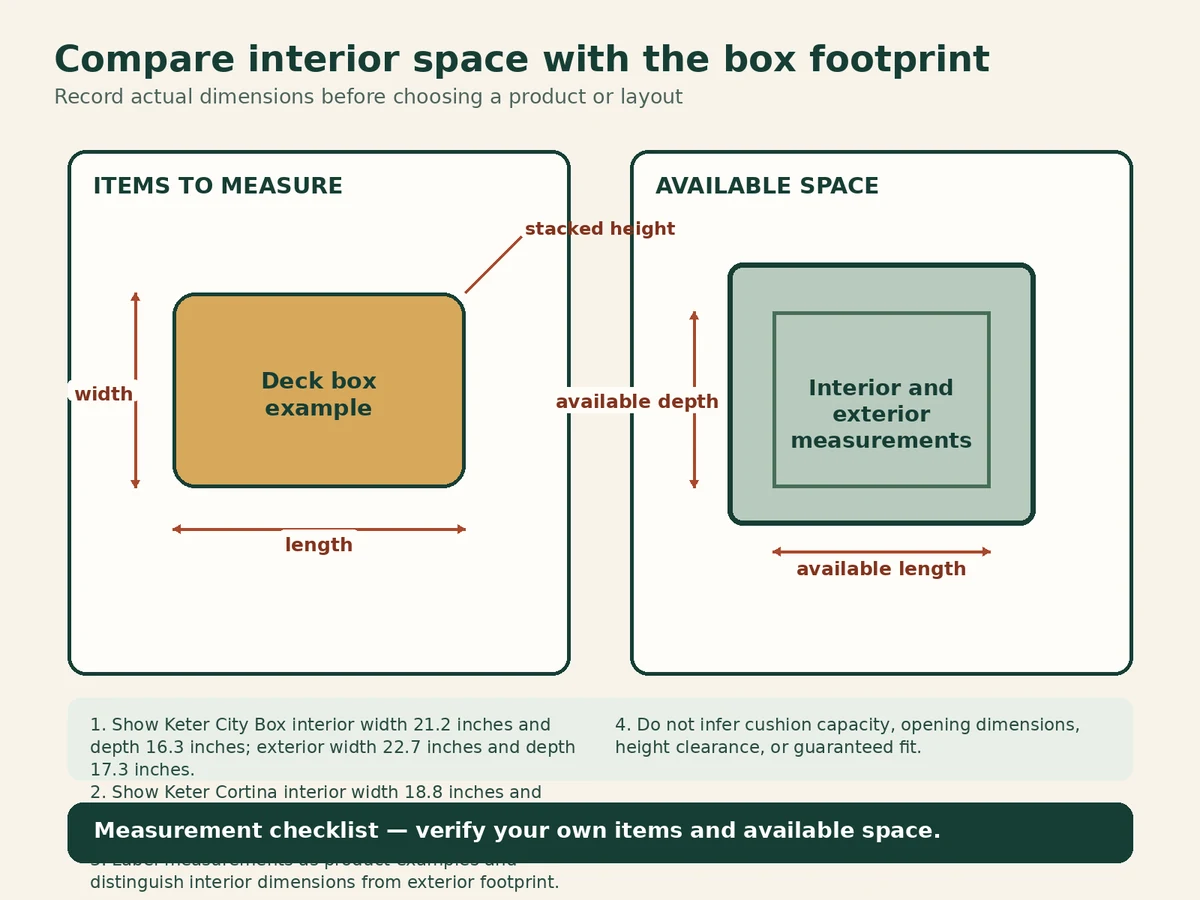
A box’s advertised capacity describes volume, but cushions need a workable arrangement inside the container. Look for the manufacturer’s interior width, depth, and height. For example, Keter lists the 30-gallon City Box at 21.2 inches wide, 16.3 inches deep, and 20.3 inches high inside; its exterior footprint is 22.7 by 17.3 inches. Those interior measurements—not the 30-gallon label—are the relevant comparison for cushions. [1]
Try at least two arrangements on paper or on the floor:
- Stack the seat cushions flat, then place softer back cushions above or beside them.
- Stand some cushions upright if their height and the box opening allow it.
For each arrangement, compare the cushion bundle’s width, depth, and height with the box’s interior dimensions. Treat a measurement that exactly matches as a warning rather than a comfortable fit: hinges, the lid opening, wall taper, rounded corners, and seams can reduce the usable space. Confirm the opening dimensions when the manufacturer provides them; an interior cavity can be larger than the path through the lid.
A second 30-gallon example shows why capacity is not standardized by shape. Keter lists the Cortina’s interior as 18.8 inches wide, 18.8 inches deep, and 18.9 inches high, with an exterior footprint of 20.8 by 20.8 inches. That arrangement is different from the City Box even though both products are labeled 30 gallons. [2]
Will a 30-gallon deck box fit cushions?
It might, but the answer depends on your cushions and their arrangement. The Keter City Box’s listed interior depth is 16.3 inches, while the Cortina’s listed interior width and depth are 18.8 inches. A cushion set that fits one shape may not fit another. Do not buy based on the 30-gallon label alone, and do not treat a manufacturer’s description of suitable items as proof that your particular cushion set will fit.
Check the small-space footprint
Measure the spot where the box will sit, including the space needed to open the lid and remove cushions. Use the box’s exterior width and depth—not its interior dimensions—to mark the footprint on your patio or balcony with painter’s tape.
Then check these practical constraints:
- Leave the walking route and furniture access usable.
- Confirm that the lid can open without hitting a railing, wall, table, or balcony door.
- Account for handles, wheels, hinges, and any part that projects beyond the main body.
- Check whether the box’s height interferes with a railing sightline or nearby seating.
- Plan where cushions will go while you retrieve or replace another item.
For a narrow patio, a taller, narrower box may preserve floor width, but only if the cushions can be stored upright and the opening is wide enough. For a shallow balcony, a box with a smaller exterior depth may be easier to place even if it requires more careful cushion folding or orientation. These are layout decisions, not conclusions that one capacity is universally best.
Use product descriptions as clues, not a fit guarantee
Manufacturer descriptions can indicate the type of storage a box is designed to handle, but they do not replace your measurements. Suncast describes its 73-gallon medium deck box as suitable for “furniture cushions, gardening supplies and other outdoor accessories.” [3] Suncast describes its 127-gallon model as suitable for “patio cushions, firewood, outdoor gear, gardening equipment and more.” [4] Neither excerpt supplies the interior dimensions needed to verify a fit for your cushions.
The same caution applies to a 22-gallon small deck box. Suncast describes that model as having 22 gallons of storage and a small footprint, but the supplied product evidence does not include its interior width, depth, height, or opening dimensions. Without those measurements, it cannot establish whether a particular cushion set will fit. [5]
A final buying checklist
Before ordering a patio cushion storage box, confirm:
- You measured every cushion’s width, depth, thickness, and quantity.
- You distinguished firmer seat cushions from softer back cushions.
- You tested both stacked and upright arrangements.
- The usable interior dimensions exceed the bundle dimensions in the chosen arrangement.
- The opening, hinges, tapered walls, and rounded corners will not block loading.
- The exterior footprint fits the patio or balcony with lid clearance.
- The product page provides enough interior and opening information to verify the fit.
The best deck box size for cushions is the smallest box whose opening, interior dimensions, and exterior footprint all work for your actual set. If a listing gives only gallons or a general storage description, treat it as a candidate—not a confirmed fit—and keep comparing until the measurements line up.
Sources
References retained with this exact revision.
- Suncast 127 Gallon Extra Large Deck Box With SeatAccessed September 24, 2026
- Suncast 22 Gallon Small Deck BoxAccessed September 24, 2026
- Suncast 73 Gallon Medium Deck Box With SeatAccessed September 24, 2026
- Keter City Box Graphite 30 Gallon Storage Deck BoxAccessed September 24, 2026
- Keter Cortina Graphite 30 Gallon Storage Deck BoxAccessed September 24, 2026