
How to Keep Water from Pooling on Patio Furniture Covers
Learn how to reduce water pooling on patio furniture covers by checking fit, creating safe high points, choosing compatible supports, and inspecting the cover after storms. This guide is tailored to small patios and balconies, where a dining set or loveseat may create awkward low spots beneath one oversized cover.
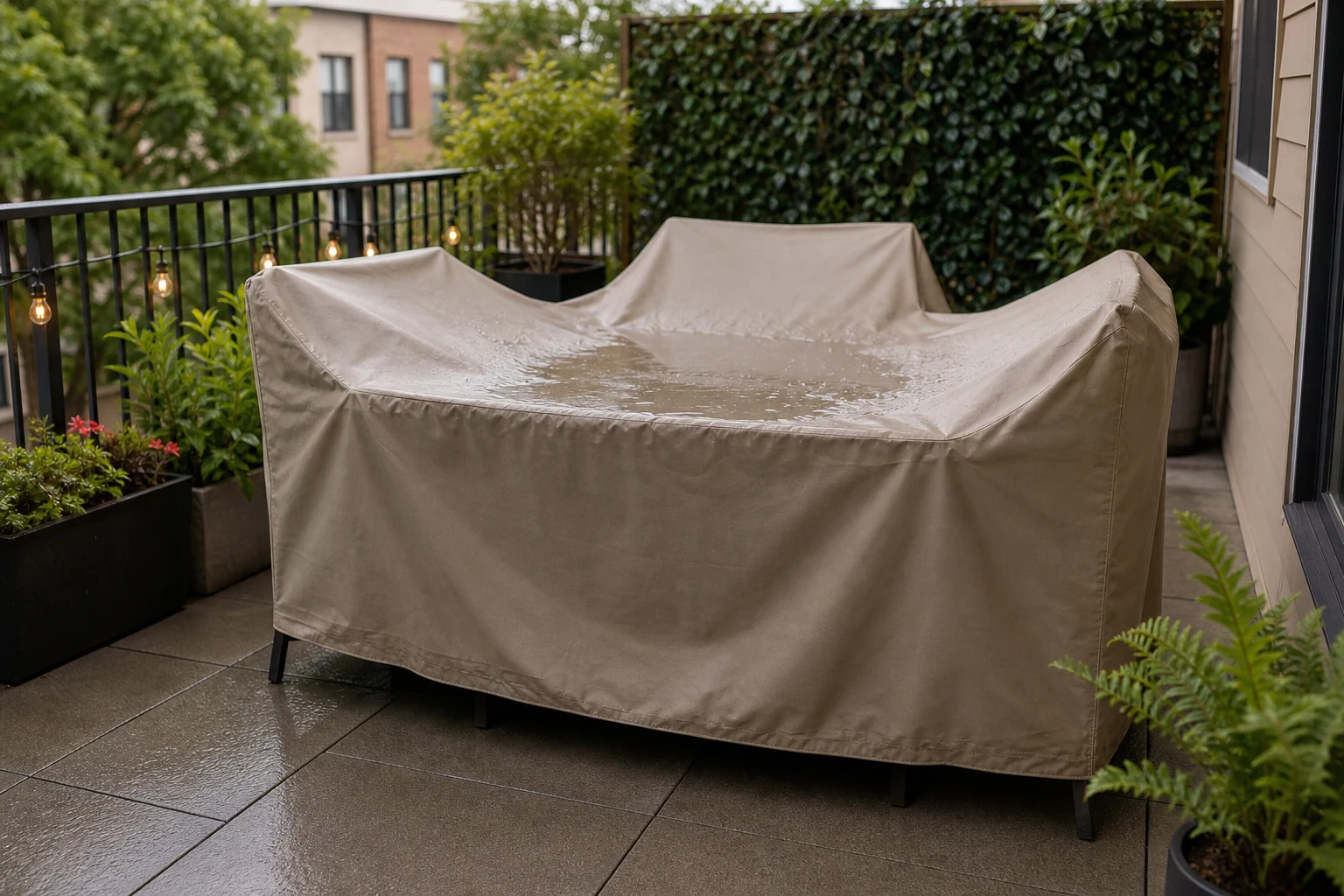
Water pooling on a patio furniture cover usually starts with the shape underneath. A loose, oversized cover can drape between taller chair backs and a lower tabletop, creating a basin where rain collects. The same thing can happen over an outdoor loveseat when the middle of the cover sags lower than its edges.
The goal is not to make the cover perfectly rigid. It is to help the cover form a shape that does not hold a deep low point, while keeping the cover compatible with the furniture and the manufacturer’s instructions. This guide explains how to check the fit, what kinds of approved support may help, and how to tell water on top from moisture underneath.
Why water collects on patio furniture covers
Water needs a low point to collect. On a small patio, one cover may span a tabletop, chair backs, armrests, and open spaces between pieces. If the fabric is loose, it can settle into the gap between a taller chair back and a lower tabletop. An oversized cover can make that dip deeper because there is more material to drape between the furniture’s high points.
A cover that looks reasonably fitted at the corners may still sag in the middle. Fasteners or drawcords can help keep a cover in place, but they do not automatically create a slope across the top. Before choosing a support, look at the cover’s overall shape after it is installed. Identify the lowest area and note whether it sits over a tabletop, between furniture pieces, or in an open section.
A sloped design can encourage runoff. Casco describes its outdoor furniture covers as having “sloped edges” that “promote water runoff.” That description supports looking for a cover shape that directs water toward an edge, but it does not mean every cover installation will shed water without adjustment.
Water on top is different from moisture underneath. Pooling on top is visible water held by a low point in the cover. Moisture underneath may come from wet furniture, condensation, damp surfaces, or water entering through an opening or seam. Do not assume that a dry-looking top proves the furniture underneath is dry, and do not assume that every damp underside was caused by top-side pooling.
Start with the manufacturer’s sizing instructions
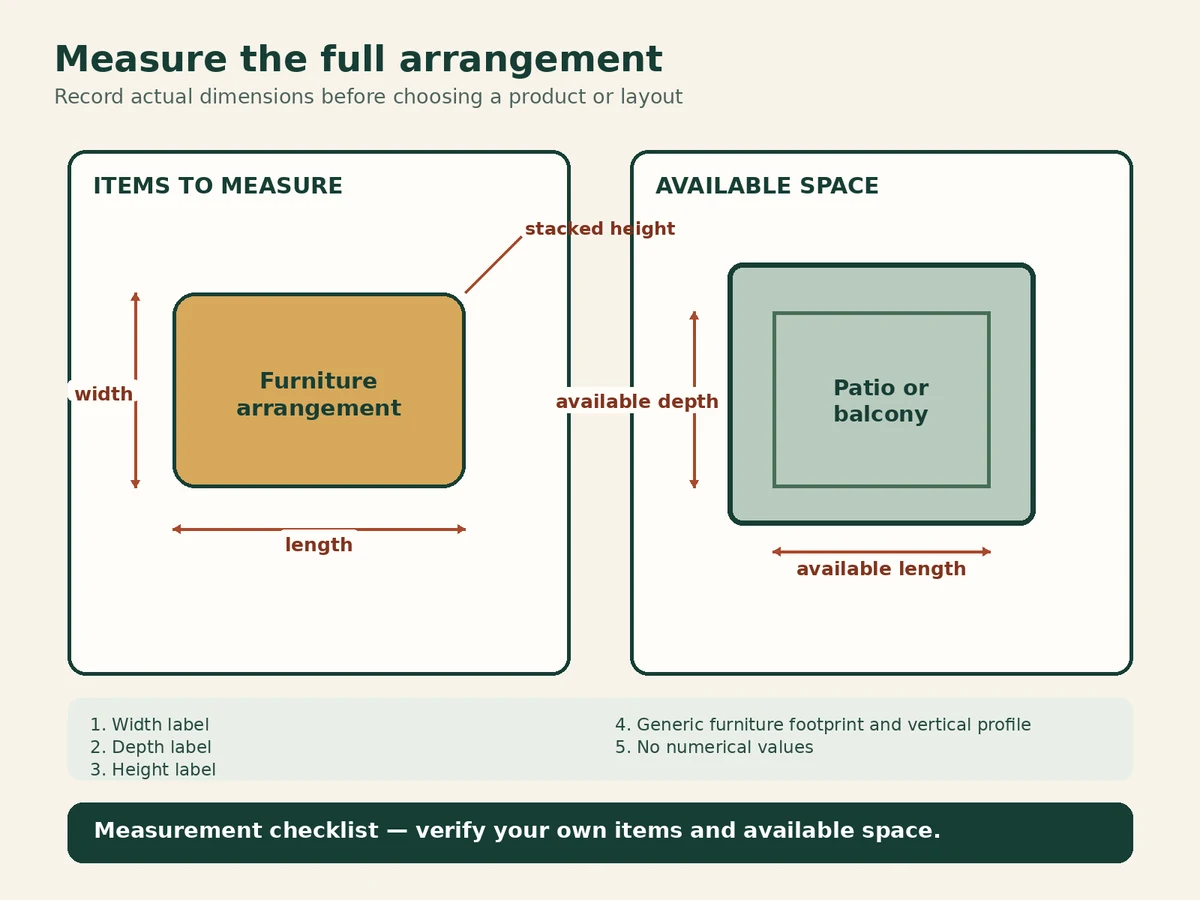
The safest first step is to compare your furniture arrangement with the cover maker’s sizing guidance. Measure the arrangement as it will actually sit: include the outermost chair backs, table edges, arms, and any other furniture that the cover must pass over. Keep the pieces in the arrangement you intend to cover.
Use the manufacturer’s instructions for how to interpret those measurements. Do not select a size solely because the cover seems close on one side. A cover that is too large may leave extra fabric across the top; a cover that is too small may fail to reach the furniture’s lower edges or leave exposed areas.
Casco’s published size list gives examples of category-based coverage, including “96″ X 96″ (4 chairs and table)” and “126″ x 96″ (6 chairs and table). Those are listed cover sizes and furniture groupings, not a universal sizing formula for every brand or patio layout. If your arrangement differs from the manufacturer’s examples, use that manufacturer’s own fit guidance or ask the manufacturer to confirm the appropriate size.
[Illustration: measurement-check]
When checking fit, inspect more than the footprint. Look at the cover’s height and the way it crosses the furniture. A cover may match the arrangement’s width and depth yet still create a pronounced low point because the furniture has uneven heights. For a balcony, also check that the cover does not obstruct a door, drain, railing, or required access path.
Create runoff without improvising unsafe supports
If the cover is correctly sized but still forms a low point, check whether the manufacturer offers a compatible air bag, approved support, or other accessory for that cover system. Follow the product’s instructions for placement and use. The support should be appropriate for the cover and furniture arrangement, not simply whatever object is available nearby.
Avoid using sharp, unstable, or heavy objects under the fabric. An improvised support can press against the cover, shift when wet, damage the furniture, or create a new low point. Do not place anything under a cover that could puncture the fabric or interfere with a chair, table, grill, heater, or electrical equipment.
A support is intended to change the cover’s shape, not to turn the furniture into a climbing surface or to hold up a person. Keep the arrangement stable and follow the cover and furniture manufacturers’ safety directions. If no approved support is available, a separate cover for each furniture group may be the more practical option.
Separate covers can reduce the amount of fabric spanning awkward gaps. For example, a table-and-chairs cover may be easier to shape than one cover stretched across a table, chairs, and a loveseat. The tradeoff is that each cover must be fitted, secured, and inspected independently. More pieces do not automatically mean better protection; they simply give you more control over each furniture group’s shape.
[Illustration: runoff-comparison]
Two small-space examples
Example 1: A small dining set
Imagine a compact dining set with a tabletop lower than the backs of two chairs. One large cover crosses the chair backs, dips toward the tabletop, and then drops toward the patio. The dip between the chair backs and tabletop is the likely pooling location.
First, measure the complete arrangement and compare it with the cover maker’s sizing instructions. Next, install the cover without forcing it over the furniture. Look for excess fabric at the top and check whether the lower edges reach the intended coverage area. If the cover is compatible with an approved support, place that support only as directed so the fabric has a higher central area and a visible path toward the edge.
If the arrangement remains a complicated shape, consider separate coverage for the table and chairs if the manufacturer offers suitable options. Before leaving the set covered, check that the cover is secure, the support is stable, and no corner or edge is trapped in a position that directs water back toward the center.
Example 2: An outdoor loveseat
A loveseat often has a broad, relatively low top compared with its arms and back. A cover can sag across the seat area if it is loose or if its shape does not match the loveseat. Water may then remain in the center instead of moving toward an edge.
Measure the loveseat’s width, depth, and height according to the manufacturer’s instructions. Check the cover after installation from both sides: a low point may be difficult to see from the front, especially on a narrow balcony. If the manufacturer approves an air bag or support for that cover, use it according to the instructions. Otherwise, ask whether a better-fitting or separate loveseat cover is available.
After rain, remove standing water according to the cover maker’s care instructions rather than pulling aggressively on a saturated section. Inspect the furniture and the underside of the cover separately before covering it again.
Common mistakes to avoid
- Choosing a cover by furniture category alone while ignoring the actual width, depth, and height of the arrangement.
- Assuming a cover that reaches the floor will also have the right shape across the top.
- Pulling the cover tightly in one direction and creating a deeper dip elsewhere.
- Using boxes, rocks, bricks, sharp containers, or other unapproved objects as supports.
- Covering wet furniture and then treating the resulting dampness as proof of a leaking cover.
- Leaving pooled water in place without checking the fabric, fasteners, furniture, and area beneath it.
- Blocking a balcony door, drain, railing, or other necessary access while trying to improve runoff.
- Treating a manufacturer’s example size as a universal fit for another brand or furniture arrangement.
A practical comparison guide
- One correctly sized cover: Best when the furniture grouping is compact and its heights create a manageable, supported shape. Check the top for low points, not just the edges.
- One oversized cover: May be convenient for a large arrangement, but extra fabric can create deeper sagging between high and low furniture. Verify the manufacturer’s sizing guidance before using it.
- An approved air bag or support: May help raise a low point when the accessory is compatible with the cover and used as directed. Confirm compatibility first.
- Separate covers: May make unusual furniture shapes easier to fit and inspect. They require separate installation and securing.
- An improvised object: Not recommended. It may shift, damage the cover, destabilize furniture, or create another place for water to collect.
Short inspection checklist
- Measure the furniture arrangement and compare it with the manufacturer’s sizing instructions.
- Check the cover’s width, depth, and height fit, including the way it crosses taller and shorter pieces.
- Find the lowest point before rain and confirm that water has a route toward an edge.
- Use only a compatible air bag, approved support, or accessory allowed by the manufacturer.
- Confirm that the cover does not block access, drains, doors, or safety equipment.
- After rain, check the cover top, furniture surfaces, and underside separately.
- Remove or correct the cause of pooling before the next storm.
The bottom line
To keep water from pooling on patio furniture covers, start with the fit and the furniture’s shape. Oversized fabric and gaps between taller chair backs and a lower tabletop can create low points even when the cover reaches the edges. Follow the manufacturer’s sizing instructions, use only compatible supports, and consider separate covers when one cover must span too many different shapes. Finally, inspect top-side water and underneath moisture as separate problems so you choose the right next step.
Sources
References retained with this exact revision.
- Outdoor Furniture Covers | Casco Manufacturing SolutionsAccessed October 2, 2026