
Outdoor Cushion Storage Bags: Can You Leave Them Outside?
An outdoor cushion storage bag can sometimes remain outside, but the answer depends on the complete product’s instructions, the exposure at your home, and how long the cushions will stay stored. Compare water-resistance language with outdoor-use directions, then choose a sheltered location and check the cushions regularly.
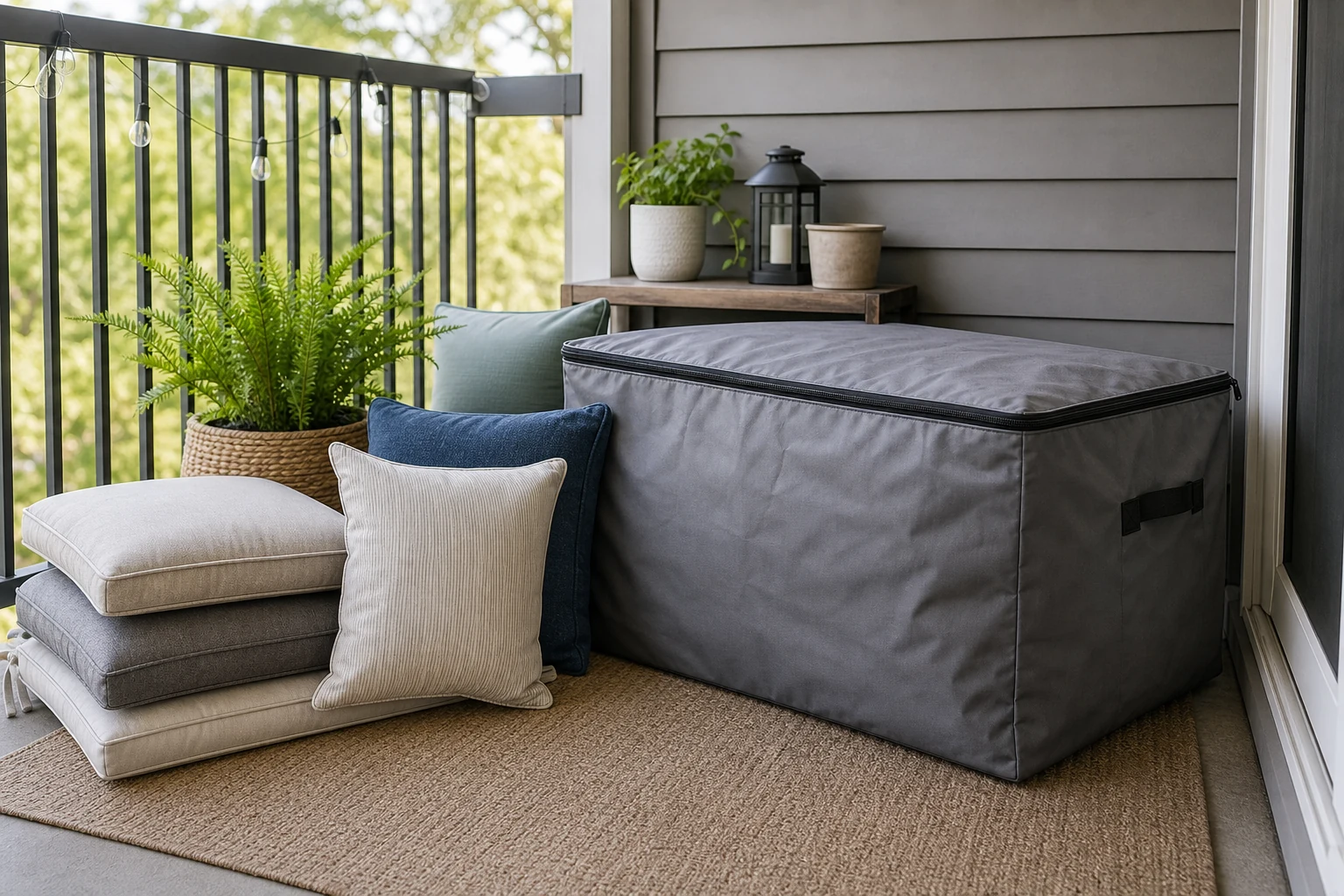
An outdoor cushion storage bag can stay outside only when the specific bag is intended for that exposure and is used as directed. “Outdoor” on a product name is not, by itself, a promise that the bag can remain in rain, snow, direct sun, or wind all season. Check the manufacturer’s instructions, consider how exposed your patio or balcony is, and distinguish short-term storage from leaving cushions packed away for months.
For many small-space households, the safest arrangement is a dry, sheltered location such as a garage, shed, or protected storage area. If that is not available, a covered balcony or patio may work for a bag whose instructions support outdoor exposure—but you still need to keep the cushions clean and completely dry before packing them.
Why “for outdoor cushions” is not the same as “leave outdoors”
A product can be made for outdoor cushions while offering only limited protection from weather. Marketing may describe a fabric as water-resistant, water-repellent, or waterproof, but those terms do not necessarily describe every seam, zipper, opening, base, or the conditions around the stored bag. The complete product’s care and use instructions matter more than a general category label.
The distinction appears in the supplied manufacturer descriptions. Classic Accessories calls its Duck Covers Ultimate Waterproof Cushion Storage Bag “waterproof” and says it is designed to protect cushions from “dirt, sun, rain, and heavy snow.” Its description also specifies heavy-duty fabrics and taped seams intended to prevent leaks. That is a stronger weather-use description than simply calling a bag an outdoor product.
By contrast, Classic Accessories describes the Veranda Patio Cushion and Cover Storage Bag as “water-resistant.” Its supplied description highlights Gardelle woven polyester fabric and a water-repellent and resistant undercoating. That tells you about the materials and treatment, but it does not establish that the particular bag should sit unprotected outdoors through every season or storm.
Treat those descriptions as product-specific evidence, not as a universal rule for every patio cushion storage bag. If the page or sewn-in label does not clearly explain outdoor placement, ask the manufacturer before treating the bag as permanent exterior storage.
Compare the instructions for the exact bag
Two bags can look similar and still be intended for different storage arrangements. Use the exact model name when checking the product page, packaging, label, warranty terms, and care guidance.
- Look for an explicit statement about outdoor exposure, rather than relying only on “outdoor cushions” in the title.
- Separate “water-resistant” from “waterproof.” The supplied Veranda description uses the former; the Duck Covers description uses the latter.
- Check whether the description addresses rain, snow, sun, seams, and leaks—not just the face fabric.
- Confirm whether the bag is meant for temporary access between uses or longer off-season storage.
- Check whether the bag must be kept sheltered, elevated, tied down, or otherwise protected. Do not assume a feature or instruction that the product page does not provide.
For example, the Duck Covers Ultimate Waterproof Cushion Storage Bag description specifically names dirt, sun, rain, and heavy snow, plus taped seams. That makes it reasonable to investigate for a more exposed location, but it still does not justify extending those claims to another Classic Accessories line or to an unverified model.
The Veranda description instead emphasizes a water-resistant construction and matching cover collection. For a balcony with a roof and little wind-driven rain, that may be a more relevant candidate than it would be for an uncovered, storm-exposed corner. The evidence supplied here does not provide a complete placement manual for that model, so confirm its current instructions before buying for exposed storage.
Coverstore’s general cover-care guidance also illustrates why storage conditions matter. It says a cover stored in a garage or shed should go in a waterproof container, while an indoor-stored cover can use a Cover Storage Bag. That guidance concerns covers rather than proving a rule for every cushion bag, but it is a useful reminder not to treat a storage bag as a substitute for a dry location without checking the product-specific directions.
Prepare cushions before putting them away
A weather-oriented bag cannot make damp cushions safe to store indefinitely. Moisture already inside the cushion, or trapped in a tightly packed stack, can create a poor storage environment even when the outer bag resists rain.
Before packing your patio cushions:
- Remove dirt and surface debris.
- Follow the cushion maker’s care label or cleaning instructions.
- Let every cushion and cover dry completely.
- Arrange the cushions without forcing them into an overfilled bag.
- Close the bag as directed, then inspect it after the first wet or windy weather.
Coverstore’s care guidance says not to put a cover back on furniture or fold it for storage until it is completely dry. Although that advice is written for outdoor furniture covers, the dry-before-storage principle is directly relevant to cushion storage decisions. The supplied Coverstore off-season article cannot be relied on here because its retrieved excerpt is not available for this revision.
A small patio or balcony also makes inspection easier if the bag is placed where you can reach it. Look for standing water, dirt around the closure, fabric damage, shifting cushions, and signs that moisture is entering. Do not open and repack cushions while they are wet; dry them first according to their care instructions.
Outdoor cushion storage bag vs. deck box
A bag is usually attractive when you need a lighter, more flexible option or have very limited floor space. It can be easier to fold or move than a rigid container, and a bag may fit a narrow balcony where a deck box would block circulation or seating. Those are practical layout considerations, not claims about any particular product’s durability or capacity.
A deck box may make more sense when you want a rigid surface, a fixed storage station, or easier access without lifting a soft container. It also takes up a defined footprint and may not suit a tiny balcony. Neither choice is automatically weatherproof: compare the manufacturer’s complete instructions for the bag or box, then consider roof coverage, wind-driven rain, snow, and how often you will open the container.
For storing patio cushions for winter, choose the arrangement that lets you keep the cushions clean and fully dry while providing the level of shelter the specific product supports. A bag in an exposed location is not automatically better than a box in a protected one, and a waterproof-sounding label does not remove the need to inspect the storage area.
A practical decision check
Use an outdoor cushion storage bag outside only if all of these answers are satisfactory:
- The exact product description or manufacturer guidance supports the exposure you expect.
- You understand whether the claim is water-resistant or waterproof and what components it covers.
- The cushions are clean and completely dry before storage.
- The bag fits without excessive compression or an awkward closure.
- The location is not more exposed than the product’s stated use.
- You can inspect the bag and respond to moisture, wind, or damage.
If any answer is uncertain, move the bag indoors, into a garage or shed, or into another protected area. If you cannot provide that kind of shelter, contact the manufacturer with the exact model before purchasing.
Bottom line
Yes, some outdoor cushion storage bags are designed to handle outdoor weather, but you should not assume that every bag can remain outside indefinitely. Compare the exact model’s instructions with your patio’s exposure, use the strongest available shelter, and store only clean, completely dry cushions. When the product language is vague, treat that uncertainty as a reason to choose a more protected location—not as permission to leave the bag outdoors.
Sources
References retained with this exact revision.
- Duck Covers Ultimate Waterproof Cushion Storage Bag | Classic AccessoriesAccessed September 28, 2026
- Veranda Patio Cushion and Cover Storage Bag | Classic AccessoriesAccessed September 28, 2026
- Cover Care | CoverstoreAccessed September 28, 2026