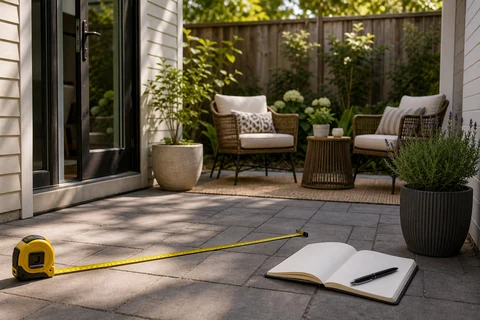
Bistro Set or Lounge Chair? Choose by Use, Not Looks
Choose the furniture type that supports your main activity, then test its complete in-use and storage footprint against your door, route, and routine.
The short answer: choose a bistro set when meals, coffee, or laptop work are the main job. Choose a lounge chair when reading and resting matter more. Choose neither until the actual open, occupied, circulation, and storage envelopes fit your measured space.
Decide What You Want to Do Outside
Write one primary activity at the top of your plan. “Sit outside” is too broad. “Eat breakfast with one other person,” “read alone for an hour,” or “work on a laptop for 30 minutes” produces a useful furniture test.
Then list the secondary activity you would be willing to give up. A small space rarely supports a full dining zone and a deep relaxation zone at the same time without regular folding, moving, or storing.
What a Bistro Set Does Better
A bistro arrangement gives each person an upright seat and a table surface. That makes it the stronger starting point for plates, cups, a notebook, or a laptop. Lowe's describes bistro sets as a small-space category and separates dining from conversation seating, but that retailer guidance does not prove any particular set will fit your patio.
Treat the table and chairs as one operating system. Record the table width, depth or diameter, and height; each chair's width, occupied depth, and seat height; and the space needed to pull a chair out. Check the table and seat heights together instead of assuming two separately “compact” items will work as a pair.
The tradeoff is movement. Two chairs may need to shift every time someone sits down, and a usable route must remain outside those occupied chair positions. Folding pieces can reduce storage volume, but only if the folded dimensions and a realistic storage location are known.
What a Lounge Chair Does Better
A lounge chair prioritizes a relaxed back angle, deeper sitting posture, and room for legs. It can be the better choice for one reader even when a two-seat dining arrangement technically fits.
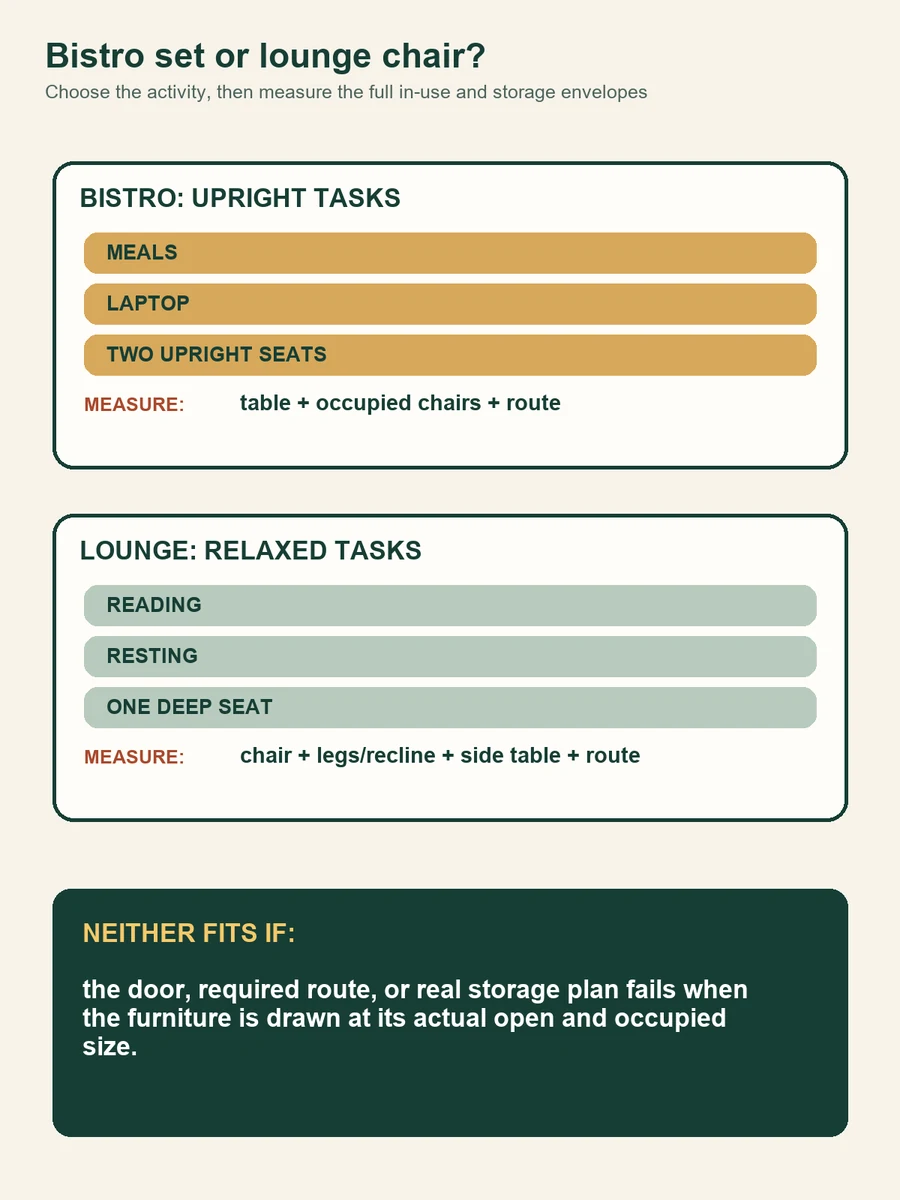
Measure the chair in the position you will actually use. A reclining model needs every documented position checked. A fixed deep chair still needs its full depth plus the user's legs, any ottoman, and a route around the occupied seat. Do not use the shipping carton or seat cushion dimensions as the furniture footprint.
Cushions add a second decision. If the manufacturer directs you to store them dry or protected, identify where they will go and how often you are willing to move them. A chair that fits outside but sends bulky cushions into a doorway every evening may not fit your routine.
Compare the Full Usable Footprints
Draw both candidates on the same measured base plan. Use the manufacturer's dated dimensions for the exact items; PatioMint has not tested products and is not substituting fictional product sizes.
Upright dining position
Draw the tabletop first. Add every chair twice: tucked and occupied. Add the pull-out movement that the manufacturer or your physical template requires. Finally, trace the route from the door to the seat without erasing the occupied-chair boxes. Use the dining guide to calculate chair-use and passing clearance.
Reclined or deep-seat position
Draw the chair at its largest documented in-use depth, then add legs, an ottoman if included, and any side table you truly need. If it reclines, swivels, or rocks, the product documentation must provide the movement information; do not invent an arc from a photograph.
Add Cushion, Cover, and Storage Work
Make three small plans rather than one optimistic plan: furniture in use, furniture folded or stacked, and cushions or covers stored. Check that the storage route is wide enough for the item you will carry and that the intended storage location matches the manufacturer's care instructions.
Commercial inspiration pages often promote fewer, smaller pieces for compact patios. Use that as a prompt to reduce the list, not as evidence that a visually light chair has a small operating footprint. Exact measurements win over appearance.
Use the Decision Matrix
- Choose a bistro set when two upright seats and a stable working or eating surface are essential, and both occupied chairs preserve the route.
- Choose a lounge chair when one relaxed seat is the priority, its largest in-use position fits, and cushion care matches your routine.
- Prefer a folding bistro option only when its open, occupied, folding, and stored states all work in the measured space.
- Prefer an uncushioned option only when the exact material and care instructions suit the exposure; appearance alone does not establish durability.
- Return to measuring when either choice requires moving furniture to open the door or reach a required route.
When Neither Option Fits
“Neither” is a successful planning result. Try one upright chair and a small movable table, a perch designed for the exact permitted location, or no permanent furniture until the route and storage problem is resolved.
Before buying, tape the largest documented footprint on the floor and rehearse the real activity. Open the door, sit where the chair would be occupied, place the items you would use, and carry any cushion toward its planned storage. If the routine fails on the floor, changing the furniture label from bistro to lounge will not solve it. For a constrained example, compare a solo and two-seat narrow-balcony plan.
Sources
References retained with this exact revision.
- How to Choose a Bistro Set for a Small Patio or BalconyAccessed September 17, 2026
- How to Choose the Best Patio Furniture for Your HomeAccessed September 17, 2026
- How to Plan Your Patio Seating SpaceAccessed September 17, 2026