Folding Outdoor Furniture: 9 Checks Beyond Folded Size
Evaluate folding furniture as a complete routine: open, occupied, folding, carrying, drying, and stored, using the exact manufacturer's documentation.
A small folded package is useful only when the furniture also fits in use, opens as documented, moves safely through your route, dries as directed, and has a real storage location.
This checklist does not assume that a chair or table has a lock, latch, safety catch, pinch warning, or particular folding sequence. Find those facts in the exact product page and manufacturer instructions; if they are absent, mark them “ask,” not “probably.”
1. A Small Folded Size Is Only the First Check
Start with the activity and the number of people. A folding label does not make a seat comfortable for dining, a table stable for work, or a set compact while occupied. Lowe's general buying guide separates size, seating, and comfort as shopping factors, but it is commercial guidance rather than verification of a specific model.
Record three states before comparing products: open and empty, occupied during the real activity, and folded for storage. Add a fourth state for the movement needed to change between them.
2. Record Open, In-Use, and Folded Dimensions
Copy the manufacturer's open width, depth, and height. Add the user's position, chair pull-out, legs, recline or swivel only when applicable, and the route around the occupied item.
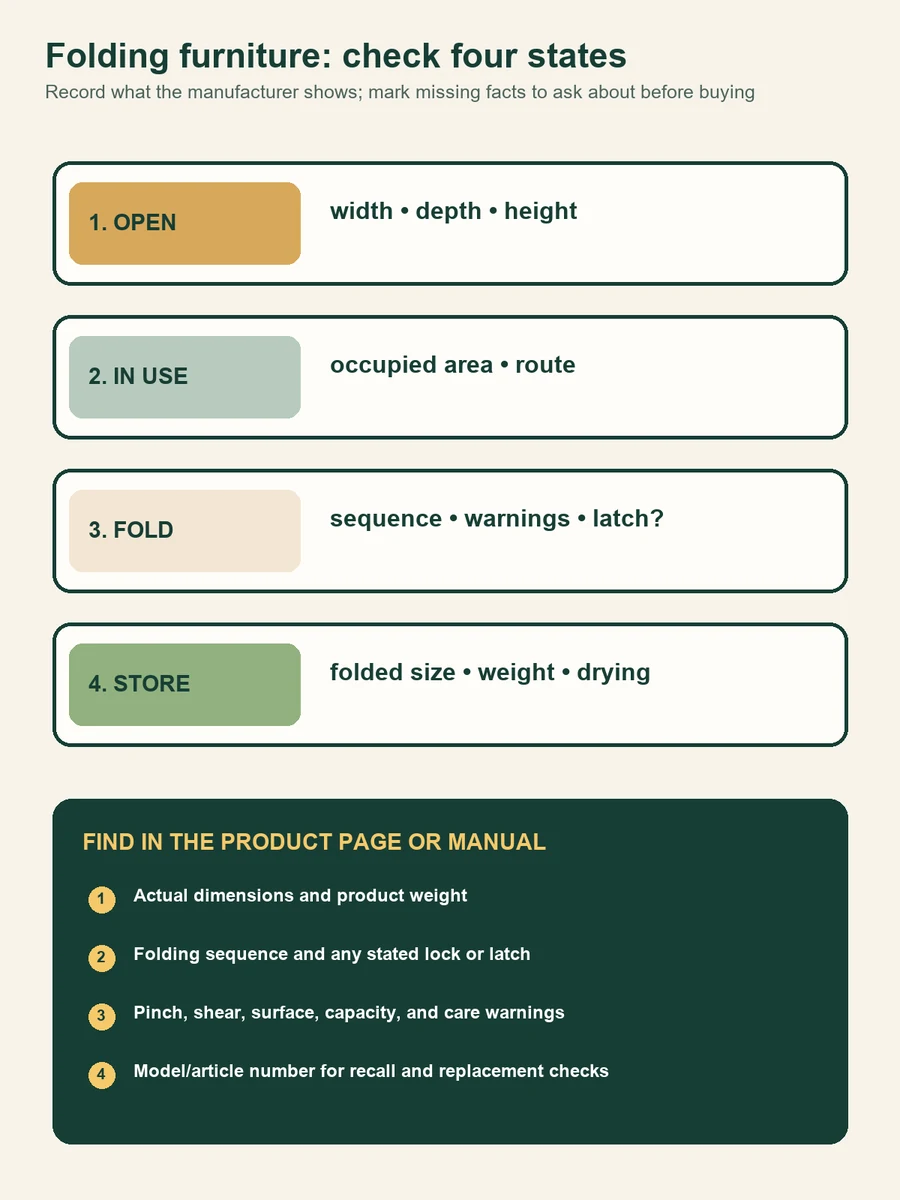
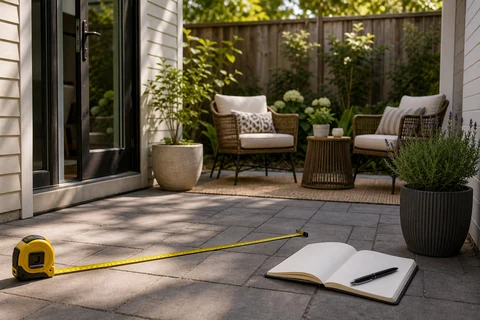
Then record folded width, depth, and height in the orientation you will store it. A thin folded profile may still be too tall for a closet or too long to turn through a doorway. Measure the storage opening, shelf, and carrying route rather than only the empty corner. To compare those states on one drawing, map every footprint on a measured patio.
3. Check the Lock and Folding Sequence
Open the exact manufacturer's instructions before buying. IKEA US, for example, directs customers to the product page's “Assembly documents” section for its products; other manufacturers may organize documentation differently.
Write down the documented sequence and whether the manufacturer identifies a lock, latch, catch, or no such feature. Do not infer a lock from a product photograph, a hinge shape, or another chair by the same brand. If the documentation is unclear, ask the manufacturer or retailer before purchase.
4. Locate Pinch and Shear Points
Look for hand-placement and pinch or shear warnings in the exact instructions. Note every moving joint the instructions identify and who must keep clear while the item opens or closes.
Do not turn a generic warning into a made-up mechanism. PatioMint's illustration intentionally shows no lock design or finger placement because those details must match the product. If the manual provides no usable operating guidance, record “absent” and decide whether that uncertainty is acceptable.
5. Check Stability, Feet, and Surface Compatibility
Read the manufacturer's surface, leveling, and inspection instructions. Record the type and condition of every foot or contact point shown for the model. Do not add pads, modify feet, or claim compatibility with decking, tile, grass, or a sloped balcony unless the manufacturer permits it.
Test the planned location with a full-size template, but remember that a template checks fit, not stability, capacity, durability, or structural load. Those require product information and site-specific review.
6. Lift It the Way You Will Store It
Find the product weight in the manufacturer data. Rehearse the route with an ordinary object only if doing so is comfortable and safe; that rehearsal is not a test of the furniture.
Check stairs, corners, thresholds, door handles, and the final shelf height. Note whether you must fold the item outside, carry it while wet, or move cushions separately. If the weight is not listed, mark it “ask” rather than estimating it from the material name. For a compact handling example, test whether a narrow-balcony routine still works.
7. Plan Drying, Covers, and Indoor Storage
Copy the exact cleaning, drying, cover, and storage instructions. “Outdoor” does not mean every model can be folded wet and placed immediately in a closed box.
Create a drying location that does not block the door or route. Check whether a cover must allow ventilation and whether cushions have separate instructions. Material-general advice from a retailer cannot override the exact care document.
8. Read Capacity, Care, and Recall Information
Use only the capacity stated for the exact model and intended use. Do not transfer a capacity from a similar chair, packaging photograph, review, or product family.
Search the US Consumer Product Safety Commission recall database using the brand, model or article number, and product type. Keep the identifier with your receipt or product record so you can search again later.
The reason for a model-specific check is concrete, but it must not be generalized. On May 5, 2021, in recall 21-127, the CPSC reported that specified outdoor wooden folding chairs sold by TJX could break and listed 18 reports, including 15 falls with minor injuries. That evidence concerns only the chairs identified in that dated recall, not folding furniture as a category.
9. Use the Pre-Purchase Checklist
For each line, mark “found,” “absent,” or “ask,” and save the source location and access date.
- Open width, depth, and height from the exact product documentation
- Occupied footprint and any documented motion envelope
- Folded width, depth, height, and storage orientation
- Manufacturer folding sequence and any stated lock or latch behavior
- Pinch, shear, hand-placement, and inspection warnings
- Product weight and a realistic carrying path
- Feet, surface, leveling, and location requirements
- Cleaning, drying, cover, cushion, and storage instructions
- Model or article number, stated capacity, and current recall search
Stop when a missing answer affects safe operation, fit, or care. A sale price, attractive photograph, or promise of “space saving” is not a substitute for the exact documentation.
Sources
References retained with this exact revision.
- CPSC Recalls & Product Safety Warnings searchAccessed September 17, 2026
- TJX recalls outdoor wooden folding chairs — CPSC recall 21-127Accessed September 17, 2026
- How do I find assembly instructions for IKEA products?Accessed September 17, 2026
- How to Choose the Best Patio Furniture for Your HomeAccessed September 17, 2026